The Words That Sound Harmless but Hurt Your Reality
In This Guide
- Introduction
- The Body Knows Before the Mind Catches Up
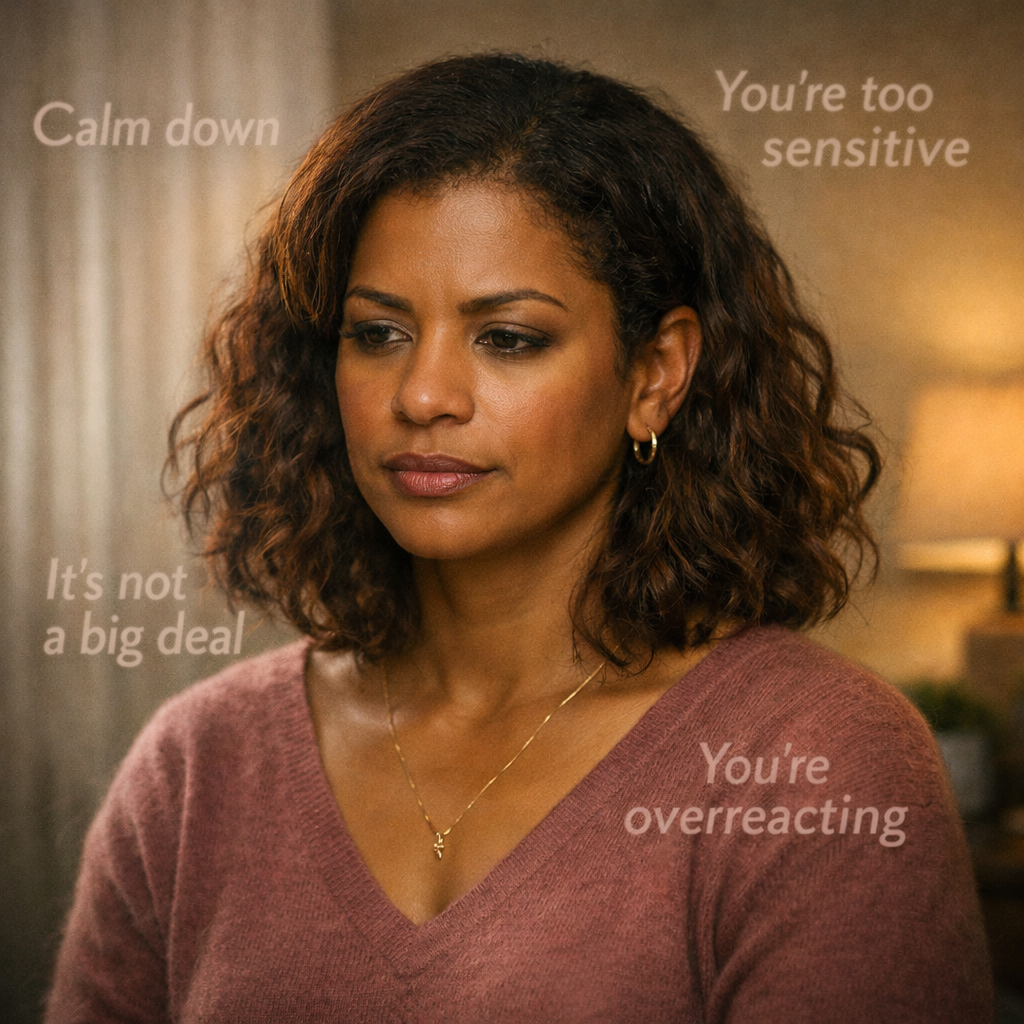
- "You're Overreacting"
- "I Never Said That"
- "You're Crazy"
- "I Was Just Joking"
- "Then Why Are YOU the Only One Who Has a Problem With This?"
- The Pattern Beneath the Words
- What to Do When You Hear These Phrases
- Conclusion
- FAQ
- References
Introduction
There's a particular kind of confusion that settles into your chest like wet cement. It spreads slowly. One moment you're sure of what you heard. The next, you're doubting your own ears, your own memory, your own sanity.
That's not an accident.
Gaslighting rarely announces itself with dramatics. It doesn't kick down the door. It slips in through the crack of a sentence that sounds almost reasonable. Almost harmless. You're left holding the shards of your reality, wondering when you became so "sensitive."
Let's name some common gaslighting phrases so you can get them out in the open. Not so you can turn around and use them on others, but so you can recognize them. Because once you see the pattern, you can't unsee it. And that's the point.
You're also far from the only one living this. National survey data on intimate partner violence in the United States found that 47.1% of women and 46.5% of men reported experiencing at least one act of psychological aggression from an intimate partner during their lifetime. The CDC defines psychological aggression as including coercive control, monitoring, threats, insults, humiliation, and other controlling behaviors (Breiding et al., 2014).
The Body Knows Before the Mind Catches Up
Before we get to the words, let's talk about what happens in your body when you hear them.
Your stomach might drop. A tightness climbs up your throat as your breathing shallows and your heart rate rises. Maybe your hands go cold.
No matter how your body responds, your mind feels confused, even unhinged, like you're standing on shaky ground while everyone else sees solid floor.
That's not confusion. That's your nervous system screaming.
When someone repeatedly questions your reality, your body may notice the danger before your mind can explain it. You're not "being dramatic." You're responding to signals that something feels unsafe. Research on the nervous system suggests that many threat responses happen automatically, outside conscious awareness, which may help explain why a knot in your stomach, a racing heart, or a sense that something is wrong often appears before you can put the problem into words (Porges, 2007).
Now let's talk about what you'll hear.
"You're Overreacting"
This one is a classic. It lands like a sledgehammer wrapped in tissue paper.
Here's what it does: it invalidates your emotional response before you even finish having it. You start to believe that your feelings are the problem, not the thing that triggered them.
The truth? Your reaction is proportionate to the wound. You’ve been conditioned to question your emotions constantly. But what if this time, your emotions are the only honest thing in the room?
Researchers who study this dynamic describe gaslighting as manipulation that specifically exploits an intimate partner's trust to make them question their own read on reality, an effect that becomes even easier to produce when a power imbalance already exists between the two people (Sweet, 2019). Being told you're overreacting is often the opening move in exactly that process.
"I Never Said That"
Oh, this one. It makes you want to poke their eyes out.
You remember the conversation. You remember the words. But suddenly, you're the only one who remembers. It's a total mind #%*#.
The sneaky part? Even if you could produce a recording, they'd find a way to reframe it. "That's not what I meant." "You're taking it out of context." Round and round it goes.
When someone denies their own words, they're not confused. They're strategically rewriting history. Your job isn't to prove your memory works. Your job is to stop engaging with someone who benefits from your doubt.
This exact pattern, denying what happened and then reframing the person who brought it up as the real problem, has a name in the research literature: DARVO, Deny, Attack, and Reverse Victim and Offender. Studies show it reliably shifts how onlookers assign blame, making the person who raised a legitimate concern look like the aggressor (Harsey & Freyd, 2023).
"You're Crazy"
This one hits different when it's someone you love.
It's designed to isolate you. If you're "crazy," then surely everyone else is right and you're wrong. You start questioning whether anyone would believe you anyway.
Here's the thing about people who genuinely struggle with mental health: they usually know it. They're seeking help. The ones who weaponize your mental health against you? They're not concerned about your wellbeing. They're concerned about one thing: control.
This tactic works because it borrows real stigma and turns it into a weapon. Research on mental illness stigma shows that being perceived as mentally unstable can lead to prejudice, discrimination, reduced self-confidence, and the loss of important social and economic opportunities (Corrigan & Watson, 2002). That's what makes accusations of being "crazy" so powerful: they do not merely challenge a person's argument. They can undermine that person's credibility and sense of self.
"I Was Just Joking"
Ah, the "just joking" escape hatch.
You've been wounded. You confronted them about it. And now you're the problem because you don't have a sense of humor. You can't take a joke.
When humor becomes a weapon, it's not humor anymore. It's a shield that protects them from accountability while leaving you as the villain for daring to express your pain.
Psychologists who study humor styles distinguish between humor that brings people together and a more aggressive style built on sarcasm, teasing, ridicule, and put-downs at other people's expense (Martin et al., 2003). When criticism is packaged as a joke, it can be difficult to challenge without being accused of "not having a sense of humor."
Going forward, remember, you get to decide what hurts you. No one else has that right! That's not sensitivity. That's self-respect.
"Then Why Are YOU the ONLY One Who Has a Problem With This?"
Isolation dressed up as logic.
They're telling you that you're the outlier. The anomaly. The problem. But here's what they won't say: they've probably said this to everyone. You're not the first person to notice the cracks. You just might be the first one who refused to deal with it anymore and to stand up and confront it.
Sometimes the crowd is wrong. Sometimes the room is full of people who've never had to face what you're facing. And sometimes, standing alone is the clearest sign you're on the right track. Commit this to your long term memory. You're going to need it again.
There's a reason this line is so effective. Research on conformity shows that people may go against their own clear, correct judgment when everyone around them is confidently saying something different (Asch, 1956). In Asch’s experiments, about 75% of participants went along with an obviously incorrect unanimous majority at least once, even though the correct answer was readily apparent. Being the only person to name a problem is not, by itself, evidence that the problem isn’t real.
The Pattern Beneath the Words
What do all these phrases have in common?
They all ask you to surrender your reality and they offer a version of events where you're the one who's broken. They question your perception, your memory, your emotions, your sanity.
And here's what most people don't realize: you don't have to accept that narrative.
None of this is just semantics, either. Being on the receiving end of these patterns is linked to measurably higher rates of anxiety, depression, and psychological distress, especially for people who were already used to going quiet about their own needs before the manipulation started (Aras & Demir-Kaya, 2026).
You are allowed to trust yourself. Not because you're perfect, but because you're the one actually living your life. Nobody else has front-row seats to your experience. Nobody else gets to tell you what you felt.
What to Do When You Hear These Phrases
First, pause. Don't respond immediately. Let the words land, and notice how your body responds.
If your chest tightens, that's information. If your stomach drops, that's information. Your head pounds? Your nervous system is paying attention even when your brain tries to talk you out of it.
Second, resist the urge to prove yourself. You will rarely win a "he said/she said" with someone who benefits from your confusion. Don't hand over your power by trying to earn their agreement.
Third, ask yourself: Does this person genuinely want to understand me, or do they want me to question myself? The answer is usually in the pattern, not the individual moment.
Conclusion
The words that hurt your reality rarely sound dangerous. They're wrapped in casual tone, disguised as concern, hidden behind a smile. But your body knows, especially your gut. That lingering doubt that won't fully leave? That's you being warned.
Trust that. Honor that. And remember: you don't have to accept a reality that costs you yourself.
FAQ
What are the most common gaslighting phrases?
Lines such as “you’re overreacting,” “I never said that,” “you’re crazy,” or “I was just joking” can, when used as part of a broader pattern of manipulation, work to undermine a partner’s confidence in their own interpretation of events. Gaslighting is especially consequential in power-unequal relationships, where perpetrators can draw on existing social stereotypes and structural vulnerabilities to erode a victim’s sense of reality (Sweet, 2019).
Is gaslighting always intentional?
Not always, but the pattern matters more than the motive. Whether or not someone can name what they're doing, repeated denial, reversal, and mockery still produce the same effect: a person who no longer trusts their own perception. If it's happening consistently and it's making you doubt yourself, it deserves attention regardless of intent.
How do I respond in the moment when I hear one of these phrases?
Start with your body rather than the argument. Pause, notice what you're feeling physically, and resist the urge to immediately defend yourself. You're not obligated to win a debate with someone who benefits from your self-doubt.
References
Aras, E., & Demir-Kaya, M. (2026). The mediating role of gaslighting as a psychological violence between self-silencing and psychological distress. Scientific Reports, 16(1), 12364. https://doi.org/10.1038/s41598-026-47134-0
Asch, S. E. (1956). Studies of independence and conformity: I. A minority of one against a unanimous majority. Psychological Monographs: General and Applied, 70(9), 1–70. https://doi.org/10.1037/h0093718
Breiding, M. J., Smith, S. G., Basile, K. C., Walters, M. L., Chen, J., & Merrick, M. T. (2014). Prevalence and characteristics of sexual violence, stalking, and intimate partner violence victimization — National Intimate Partner and Sexual Violence Survey, United States, 2011. MMWR Surveillance Summaries, 63(8), 1–18. https://www.cdc.gov/mmwr/preview/mmwrhtml/ss6308a1.htm
Corrigan, P. W., & Watson, A. C. (2002). Understanding the impact of stigma on people with mental illness. World Psychiatry, 1(1), 16–20. https://pmc.ncbi.nlm.nih.gov/articles/PMC1489832/
Harsey, S. J., & Freyd, J. J. (2023). The influence of deny, attack, reverse victim and offender and insincere apologies on perceptions of sexual assault. Journal of Interpersonal Violence, 38(17–18), 9985–10008. https://doi.org/10.1177/08862605231169751
Martin, R. A., Puhlik-Doris, P., Larsen, G., Gray, J., & Weir, K. (2003). Individual differences in uses of humor and their relation to psychological well-being: Development of the Humor Styles Questionnaire. Journal of Research in Personality, 37(1), 48–75. https://doi.org/10.1016/S0092-6566(02)00534-2
Porges, S. W. (2007). The polyvagal perspective. Biological Psychology, 74(2), 116–143. https://doi.org/10.1016/j.biopsycho.2006.06.009
Sweet, P. L. (2019). The sociology of gaslighting. American Sociological Review, 84(5), 851–875. https://doi.org/10.1177/0003122419874843